Last Updated: November 22, 2026
Quick Summary
To check flood risk before buying Queensland property, search the exact street address on FloodCheck Queensland, then order a property-level flood report from the local council. Compare the mapped result with the property’s flood history, and check the floor level against the mapped flood level before making an offer.
- Search the exact property address on FloodCheck Queensland’s statewide flood mapping tool.
- Order a property-level flood report from the local council, since products and terms differ by council.
- Separate recorded historic flood maps from modelled scenarios, which show possible future flooding.
- Check the habitable floor level against the mapped flood level, as they can differ.
- Ask your insurer about flood cover, exclusions and premiums at the address before committing.
Table of Contents
- Step-by-Step: Checking a Queensland Property for Flood Risk
- Official Queensland Flood Mapping Portals and Property Reports
- Questions to Ask Before Making an Offer on a Flood-Prone Property
- Frequently Asked Questions
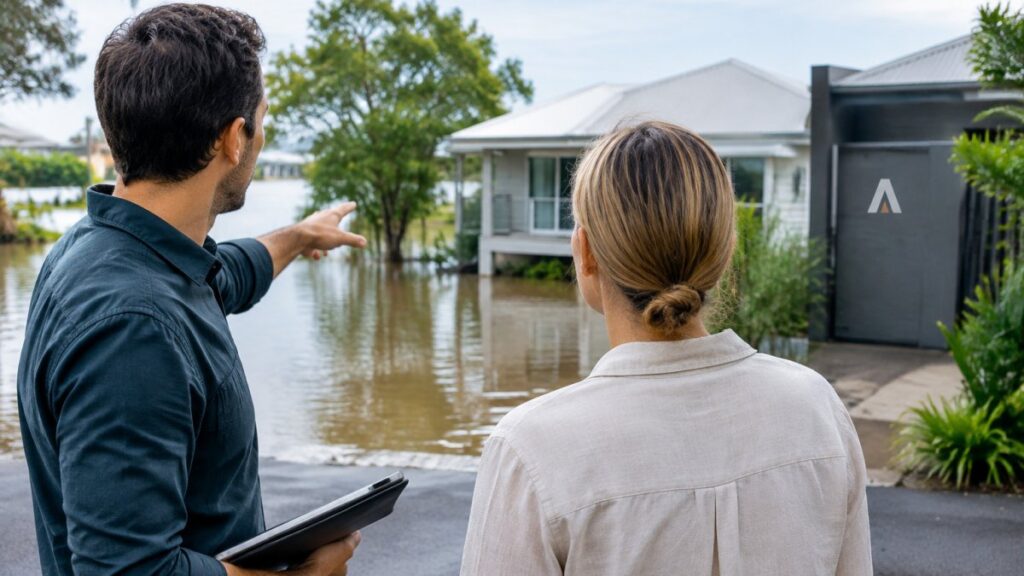
Buying on the Sunshine Coast is a big financial decision, and flooding is a risk most buyers overlook. Many insurance policies exclude or limit flood damage, so knowing a property’s flood history early helps avoid expensive surprises.
Step-by-Step: Checking a Queensland Property for Flood Risk
Start with the property’s exact street address, because flood risk is decided property by property. For hinterland and acreage land, the Sunshine Coast Hinterland acreage buyer checks cover the flood exposure checks specific to that kind of property.
- Search the property address on FloodCheck Queensland. The state map shows flood plains, modelled flood maps and historic flood maps; note the flood source and the scenario shown. FloodCheck Queensland statewide flood mapping tool
- Order a property-level flood report from the local council. Products and terms differ by council, so ask what it calls its property-level flood product before you order. Brisbane City Council FloodWise Property Report
- Separate recorded history from modelled scenarios. Historic maps show where water has been recorded; modelled maps show where it could go under a defined scenario.
- Compare the mapped result with the property’s history. Ask the seller or agent whether the property has flooded before, and cross-check against council records and state historic maps.
- Check the floor level against the mapped flood level. A property can be mapped as flood-affected while the habitable floor sits above the modelled level, or mapped as low risk while a garage is vulnerable.
- Look beyond the boundary. Check access roads, evacuation routes, local drainage and nearby waterways; a dry block can still be isolated if the only access road floods.
- Write down what you find and what you still do not know. Note the flood type, likelihood, floor level information and gaps for your insurance quotes and conveyancer questions.
A clear map result does not mean the property is safe. Maps show what is modelled or recorded, not every future event, treat disagreement between sources as a finding to investigate.
The steps below set out what to do, and the time or frequency each one takes, when checking a Queensland property for flood risk.
| Step | What to do | Note |
|---|---|---|
| 1 | Search the address on FloodCheck Queensland | Note the flood source and scenario shown |
| 2 | Order a property-level flood report from the council | Products and terms differ by council |
| 3 | Separate recorded history from modelled scenarios | Historic shows recorded; modelled shows scenarios |
| 4 | Compare mapped result with the property’s history | Ask seller or agent and cross-check records |
| 5 | Check floor level against mapped flood level | Floor level can sit above modelled level |
| 6 | Look beyond the boundary | Access roads and evacuation routes can flood |
| 7 | Write down findings and remaining gaps | Use for insurance quotes and conveyancer questions |
Official Queensland Flood Mapping Portals and Property Reports
Use the state tool for a broad view and the local council report for detail.
- FloodCheck Queensland: statewide flood plains, modelled and historic maps, imagery and reports.
- Local council property flood reports: property-level risk, historic flood levels and aerial maps where provided.
- Your conveyancer or buyers agent: can help pull these together before you commit.
Flood reports use terms such as flood likelihood, flood extent and floor level; ask a professional if a term is unclear.
Questions to Ask Before Making an Offer on a Flood-Prone Property
If the property shows a flood risk, ask these questions before making an offer.
Ask the seller or agent: Has the property flooded before, and when, date, depth and whether the claim was insured? What is the floor level compared with ground level and nearby waterways? Have any flood mitigation works been done, and are there records? Are there easements, drainage reserves or overland flow paths affecting the block?
Ask the council or check yourself: What flood source affects the property (river, creek, overland flow, storm tide)? Which modelled scenario does the report show, and what does the historic map show? Can you get home and leave safely in heavy rain, and what do local evacuation routes look like?
Ask your insurer before you commit: Will the insurer cover flood damage at this address, and at what premium and excess? Are there exclusions for overland flow, storm tide or repeated flooding? Does the quote change if the property has a prior flood claim?
Ask your conveyancer about timing: Does the contract give you time to finish flood checks before conditions or deadlines expire? Which searches should be ordered, and when? If searches reveal a flood issue, what are your options under the contract?
Many buyers find a buyers agent can handle these checks, read more in our guide to using a buyers agent, or see our property due diligence guide.
Elevate Buyers Agents can run these checks before you make an offer. Browse our Sunshine Coast flood resilient housing guide for more on flood-resilient homes.
Frequently Asked Questions
How do I check whether a property is in a flood zone?
Start with the FloodCheck Queensland map, a state government application that shows floodplains, modelled flood extents and historic flood maps. Enter the property address and check whether it sits inside a mapped flood area. Then request a property-level report from the local council, which typically shows flood risk type, recorded historic flood levels and aerial maps. Read the map legend carefully, because the boundaries are indicative and a property near a mapped edge may still be affected. Keep a record of what you checked and when, and ask your conveyancer to confirm the findings before you sign the contract.
Can a property flood even if it is not shown on a flood map?
Yes. Flood maps show modelled and recorded flood extents, but they cannot capture every source of water. Overland flow, stormwater drainage failures and localised flash flooding can affect properties outside a mapped floodplain. Maps are also updated periodically, so newer events may not yet appear. Treat a clear map result as a useful starting point rather than a guarantee, and ask the seller and neighbours directly about any water that has entered the property or nearby streets.
Does flood risk affect home insurance premiums or availability?
It can. Most standard home insurance policies in Australia exclude or limit flood cover, so you may need separate flood cover or a specific policy extension. Premiums and excesses can be higher for properties in mapped flood areas, and some insurers decline cover altogether. Before you make an offer, ask an insurer or broker for a quote on the specific address. Insurance availability and cost can affect your finances and the property’s resale value, so confirm it before you commit to a purchase contract.